There's one number that quietly decides your lap time, and almost nobody is looking at it while it still matters. It's not your top speed on the straight. It's how slow you got in the corner before it.
If you've spent any time reading about the racing line, you've run into the idea that the apex — the slowest, tightest point of a corner — is where the lap is really won or lost. There's a clean piece on this from Paradigm Shift Racing that lays out the physics better than most: when a car is at the limit, speed and line radius are linked. A tighter radius forces a lower speed; a higher speed demands a bigger radius. The slowest point of the corner is the tightest point — the apex — and the speed you carry through it is your minimum speed.
Here's why that one number matters more than any other: your minimum speed is the starting speed for the entire next straight. Two cars come out of the same corner; the one that carried two extra mph through the apex is ahead at the exit and stays ahead all the way down the straight. The lead doesn't wash out — it compounds. And, counterintuitively, it compounds regardless of how long the straight is. A longer straight doesn't let the slower car catch up; it just gives the faster-minimum car more track to be ahead on. That's the part that flips people's intuition. We obsess over top speed and braking points, but the lever that moves everything downstream is the speed at the slowest point.
So if minimum speed is the number that decides the lap, the obvious question is: do you actually know yours?
Most drivers don't — not in any usable way. You feel fast through a corner, but "felt fast" and "carried 3 mph more than last lap" are very different things, and your body is a terrible instrument for telling them apart. The data exists — any GPS logger captures it — but it's trapped in a spreadsheet you'll squint at on Tuesday night, long after the corner that mattered. By then the feeling is gone. The data lived in one place and the driving lived in another, and the two never met at the moment they actually counted: at speed, mid-corner, with your hands full.
That gap is the whole reason RaceVoice exists. Drive Faster. Eyes Up.
How RaceVoice finds your minimum speed — in real time
Before you drive, you break the track into segments — the corners and sections you care about — each with a start and a stop point. (On RaceVoice's 250+ built-in tracks, the corners are already marked; you just turn on the callouts you want.) For each segment you can ask for three numbers: your entry speed, your minimum, and your exit. Those three numbers are what actually decide a corner.
Out on track, here's what's happening under the hood. The app reads your phone's GPS about ten times a second. The moment you cross a segment's start point, RaceVoice starts watching — and on every single GPS tick inside that corner, it asks one question: is this the slowest I've been so far? If it is, that becomes the running minimum. It keeps doing that, sample after sample, all the way through the corner. When you cross the segment's exit, it has your true minimum — the genuine slowest point of that corner on that lap, not a guess and not a feeling.
And then — this is the part that matters — it tells you. Out loud. "Minimum… fifty-two." A real voice, at the exit of the corner, while the next corner is still ahead of you and you can still do something about it. You never look down. The screen — the Live Coaching HUD with your lap clock, gap to your best lap, live speed, and G-forces — is there as backup, but your ears do the coaching. That's the patented idea at the core of the product (U.S. Patent 11,151,900): location-aware, voice-first coaching that meets you where you are on the track.
A couple of honest details, because the how matters. The voice you hear is a "Minimum" clip stitched seamlessly to the number, so it lands as one natural phrase instead of two robotic chunks. And RaceVoice only speaks sane numbers — it won't call out a "minimum" from when you were crawling through the paddock or sitting on pit lane. On the free tier you pick one callout per corner; paid drivers can stack entry, minimum, and exit together.
Why hearing it changes how you drive
Once your minimum speed is a number in your ear instead of a feeling in your gut, something shifts. You stop guessing and start chasing. You come through your problem corner and hear "fifty-one." Next lap you trust the front a hair more and hear "fifty-three." That's not a vibe — that's two mph of corner speed you just confirmed, carried onto the straight, banked for the rest of the lap. You creep up on the fast guys' numbers without gambling the car to find them, because the number tells you exactly how much you found.
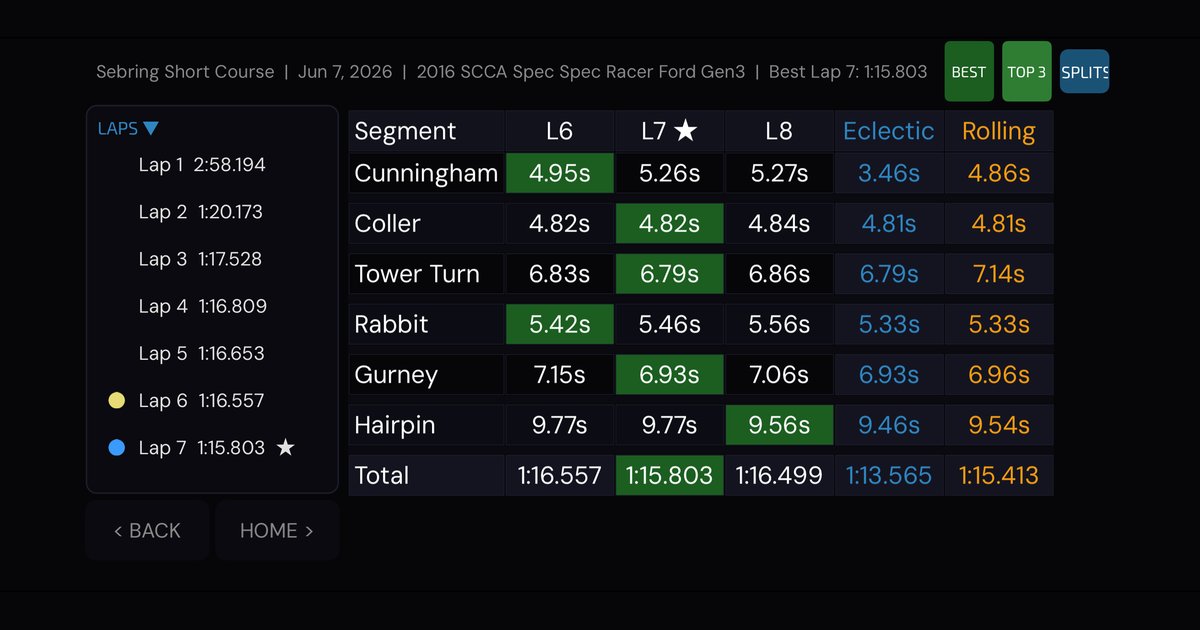
After the session, the same minimum-speed math drives the review. RaceVoice's segment splits show your entry, minimum, and exit for every corner, every lap, with the fastest version in green — so you can see at a glance which corner is costing you and whether the fix is entry, apex, or exit. (The splits pictured above are example laps in an SCCA Spec Racer Ford at Sebring.) It even builds your "eclectic" lap: your theoretical best, stitched from your fastest version of each segment, so you know what you're capable of today, not just what you happened to string together. (And yes — the Bloopers reel works off the same number, hunting down the corners where your minimum speed fell off a cliff. Educational and funny.)
The point
The racing-line theory has been clear for a long time: minimum corner speed is the lever that moves your whole lap. What's been missing for everyone without a race engineer in their ear is a way to know that number while it's still actionable — not on a spreadsheet Tuesday night, but at the exit of the corner, eyes up, hands full, with the next corner coming.
That's the number RaceVoice was built to give you. Out loud. In the moment. While it still matters.
Follow along as I build RaceVoice in public.
#RaceVoice · #DriveFasterEyesUp · #SpeedOfVoice · #Motorsport · #DriverCoaching · #MotorsportTech · #HPDE · #SpecRacerFord