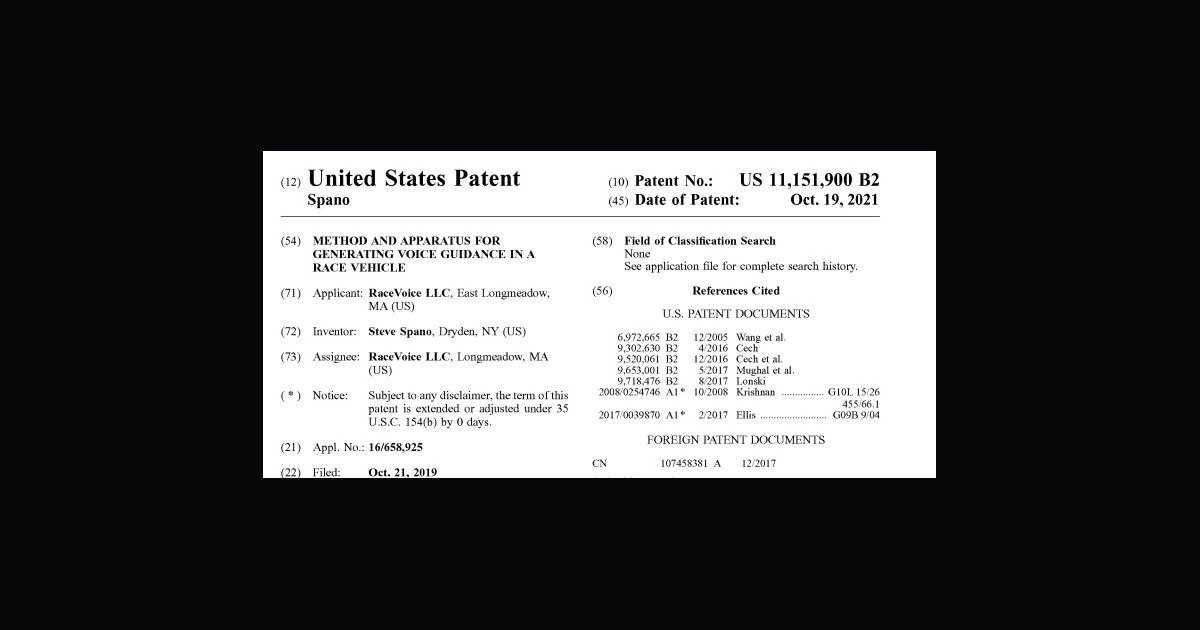
The first time I really wanted RaceVoice, I was going through Turn 1 at Watkins Glen, chasing faster guys into the bus stop. They were carrying speed through that corner I just couldn't touch — and I wanted a way to creep up on their numbers without putting my car in the wall. That want is the whole reason U.S. Patent 11,151,900 exists.
Every driver who has ever stared at a dash logger knows the trap. The data is right there — speed, brake pressure, G, the whole picture of the lap you just drove. And to read any of it, you have to do the one thing the track will punish you for: look down.
I spent years on that contradiction. I race a Spec Racer Ford, and like everybody else at an SCCA weekend I had data coming out of my ears — AiM and MoTeC loggers capturing everything the car did. The problem was always Turn 1 at the Glen, and a hundred corners like it. I'd watch the quick guys sail through and carry speed into the bus stop that I couldn't match, and I knew the answer was in my data somewhere. But after every session you'd huddle over a laptop, scrubbing through traces, trying to turn a wall of numbers into one thought you could actually use. By the time you got back on track, the feeling was gone. The data lived in one place and the driving lived in another, and the two never met at the moment they actually mattered — at speed, mid-corner, with your hands full.
Somewhere in there the obvious thing finally landed on me: the car already knows. The logger already knows my entry speed into that corner, my minimum through the apex, what I carried out. I don't need to see any of that. I need someone to tell me, at the exact point on the track where it's still useful. Eyes up. Let the car talk to you.
That's the idea that became RaceVoice. Not another screen. A voice.
Building it (2017–2018)
I didn't write it down and wait. I built the thing. Over about eighteen months across 2017 and 2018 I designed and track-tested a standalone in-car device — a small unit built around a dsPIC33EV microcontroller with an active CAN cable that tapped the data already flowing out of the driver's AiM or MoTeC logger. It read the live telemetry off the CAN bus and spoke to you through speech synthesis: your corner entry speed, your minimum, your exit, your shift points, brake-threshold tones — the coaching a good instructor gives you, except it never got tired and it always knew exactly where you were on the track.
The testing was the real work. Plenty of ideas survive on a whiteboard and die in Turn 1. The first time it really clicked, I was back through that exact corner at the Glen, and the voice was feeding me my speed as I came up on it — "74… 75… 76." And I remember thinking: that doesn't feel so scary. I can take a little more. That's the whole invention in one sentence. The moment you stop reading and start listening, your eyes go back where they belong — out the windshield — and you find the next tenth of a mile an hour without ever gambling the car to get it.
I wasn't alone in it. I built the original RaceVoice with two fellow SCCA racers, James Regan and Dave Auer. Jim brought the driving — he's been racing for years, he's fast, and just as important for a coaching device, he's consistent. His repeatable laps gave us clean reference data and made RaceVoice's callouts sharper. Dave got us to market — he organized the website launch and brought in our first sales. We put the thing in front of real drivers as fast as we could.
Filing it (October 2019)
By 2019 the invention was real enough and tested enough to protect. We filed the patent application on October 21, 2019 — internally it was FLC001P — covering the core method I'd been chasing the whole time: let a driver select points or sections on a track before driving, then announce chosen parameters out loud the instant the vehicle reaches them. Entry, minimum, and exit behavior through a section. Comparison against your previous performance. Review afterward. The claims describe, in patent language, the exact thing I'd felt in the car at the Glen: location-aware, voice-first coaching that meets you where you are on the track.
The drawings (FLC001P_DWGS.pdf in our archive) lay it out — the device, the data path, the segment-by-segment logic. Reading them back now, years later, they're a blueprint for an app I hadn't yet figured out how to build.
Prosecuting it (2019–2021)
Patents are not granted because you had a good idea. They're granted because you survive the examiner. Ours took the normal beating — the back-and-forth through 2020, a Rule 132 declaration to defend the inventive step, the grind anybody who's been through prosecution will recognize. We'd filed the "RACEVOICE" trademark in December 2018 alongside it.
And it held. On October 19, 2021, the application issued as U.S. Patent 11,151,900. The idea I'd felt in a race car chasing the bus stop was now, officially, a protected method.
Why the patent still matters in 2026
Here's the part I didn't see coming. The original RaceVoice was hardware — a box wired into a race car, reading a dedicated dash logger over CAN bus. It worked, drivers bought it, and it did real good (more on that company another day). But a CAN-bus device only ever reaches the small number of people willing to wire one in.
The patent wasn't about the box. It was about the method — location-aware, voice-first coaching. And a method doesn't care what hardware it runs on.
In 2026 that method runs on a phone. The 2026 RaceVoice app needs no dash logger and no CAN cable. It uses the phone's own GPS and IMU — and its camera — to do what the device did: call your entry, minimum, and exit speeds out loud, at the right point on the track, eyes up. Same idea, finally in everyone's pocket instead of bolted into a race car.
I'll be straight about one thing, because the history makes it easy to blur. The original hardware also did engine monitoring — low oil pressure, high coolant temp, low voltage — and it saved real cars at real events. The 2026 app does not do that. It has no dash logger and no engine-fault alerts. It's a speed coach: GPS, IMU, camera, and the patented voice-guidance idea, focused entirely on making you faster. The eyes-up insight is the through-line. The engine-protection side of the old box belongs to the old box.
That's what a patent really is, when it's a good one. Not a trophy. A bet that the idea will outlive the version of it you can build today. I made that bet, filed it in 2019, and watched it issue in 2021. Now, in 2026, the idea is exactly where it always wanted to be — in the driver's ear, on a device every driver already owns.
Eyes up. Let the car talk to you. It finally can, for anyone.
Follow along as I build RaceVoice in public.
#RaceVoice · #DriveFasterEyesUp · #SpeedOfVoice · #Motorsport · #DriverCoaching · #MotorsportTech · #HPDE · #SpecRacerFord