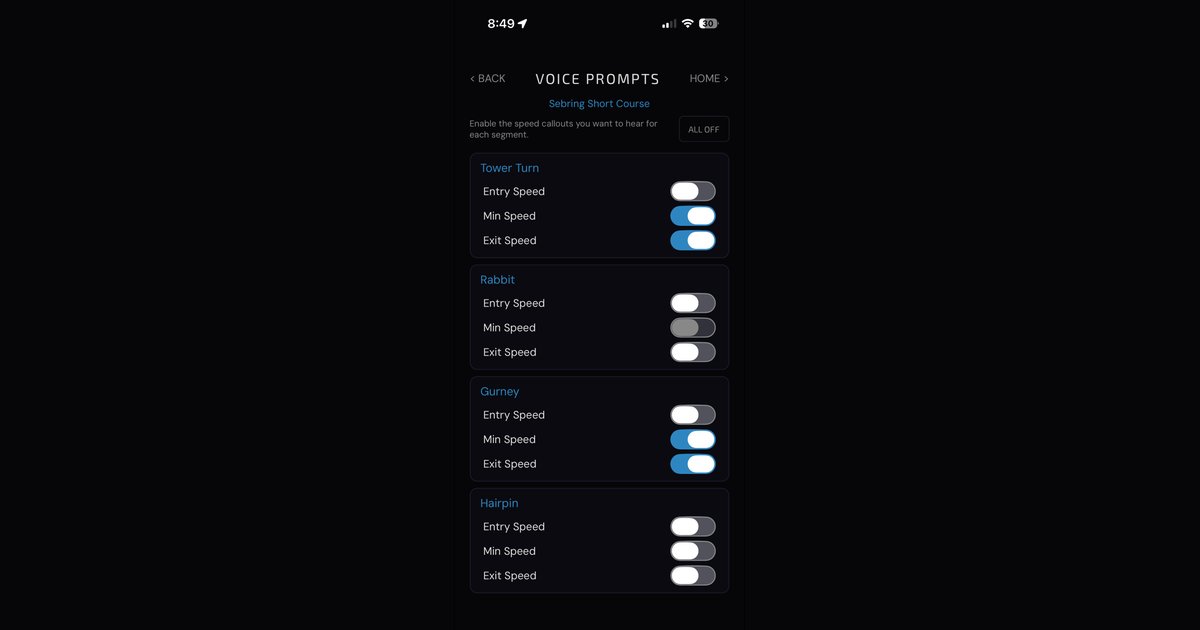
People ask me how RaceVoice "generates" the coaching — like there's a model somewhere deciding what advice you need. There isn't. The best coaching isn't advice at all. It's a number: the speed you just carried through this corner, in your car, said out loud at the exact spot where you can do something about it. The whole system is built to deliver that one true number at the right moment, lap after lap. Here's how — and why that's the version that actually makes you faster.
The coaching is not an opinion
Let me start with what RaceVoice deliberately does not do. It does not tell you to brake later. It does not tell you you're "2 tenths off." It does not hand you a target speed and scold you for missing it. There's no AI in your ear inventing instructions. It tells you one thing: the speed you just drove, where you drove it.
That's a design choice, and it comes straight out of the patent. U.S. Patent 11,151,900 doesn't describe a system that judges you. It describes a method: let a driver mark sections of a track before driving, then announce chosen parameters of the vehicle's own behavior out loud the instant the car reaches those sections — entry, minimum, and exit through a corner, compared against your own previous runs. The invention isn't a coach with opinions. It's a way to hand you a fact you already produced, at the only moment it's useful.
I believe in that distinction because of how driving actually improves. A number you achieved is something you can trust and repeat. An instruction is something you have to interpret, second-guess, and translate into your hands and feet while doing 90 into a braking zone. "Carry more speed" is noise. "Forty-one" — said right as you hit the apex where you ran forty-one last lap — is signal. You know instantly whether you've got room for forty-two.
Where the numbers come from
So if the coaching isn't generated, what is the logic? It's geometry and a stopwatch. Here's the actual pipeline.
Every track in RaceVoice is a path of GPS points, and on that path you (or the auto-detector) define segments — named stretches, usually corners, each with a START coordinate and a STOP coordinate. Those two points are the entire definition of "this corner" as far as the coach is concerned.
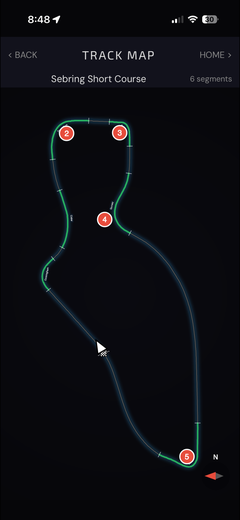
The lap, broken into segments. Each numbered corner is a START/STOP pair — that's all the coach needs to know where "this corner" begins and ends.
While you drive, the phone feeds GPS in at roughly 5 ticks a second. A small state machine watches your position against every segment's START and STOP markers. The logic is almost embarrassingly direct:
- When you come within about 200 feet of a segment's START, the corner "arms," and the moment you cross it the app captures your entry speed.
- While you're inside the segment, it tracks the minimum speed — the lowest number you hit, which on a real corner is your apex speed.
- When you cross the STOP marker, it captures your exit speed and the corner is complete.
That's it. No curve-fitting, no inference, no model. Three numbers per corner, measured off your own GPS trace: entry, minimum, exit. The same engine runs live in the car and afterward in Data Review — one code path, so the number the voice gives you mid-corner is exactly the number you'll see on the chart later. (A couple of sanity rails: speeds below ~20 mph or above ~180 are ignored, so a pit crawl or a GPS glitch never gets announced.)
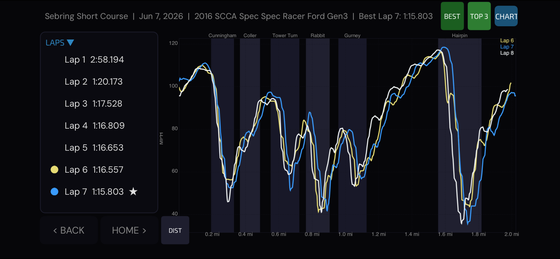
The same segments, seen as speed. Every shaded band is a corner; the dip inside it is your minimum speed, with entry on the way down and exit on the way back up — the three numbers the voice reads you.
Saying it at the right instant — the hard part the patent saw coming
Measuring the number is easy. Delivering it is the whole invention, and it's the part people underestimate.
Coaching that arrives a beat too late is coaching you can't use. If the voice tells you your entry speed after you've already turned in, you've learned a fact about the past. So the segment isn't drawn tight around the painted curbing — it carries a short lead-in and lead-out, roughly 200 feet on each side. The entry callout lands before you commit to turn-in, while your foot can still negotiate. The exit callout covers track-out, while you're still feeding in throttle. The number meets you slightly ahead of the action, every time.
And it's spoken, not shown. This is the "Eyes Up" half of "Drive Faster. Eyes Up." The numbers are pre-rendered into short voice clips, so "Entry… seventy-four" plays as one clean phrase the instant you cross the marker — no glance at a screen, no reading a trace, no looking down at the one moment the track will punish you for it. Your eyes stay out the windshield. The car talks; you listen.
That sequencing — mark the sections beforehand, then announce the chosen parameters at the location they apply — is almost word for word what the 2019 patent application claims. The original RaceVoice was a hardware box wired into a Spec Racer's CAN bus reading a dedicated dash logger. In 2026 the exact same method runs off a phone's GPS. The hardware changed completely; the logic of coaching didn't, because the logic was never about the hardware. It was about meeting the driver where they are on the track with a number they can act on.
Why it has to be your number, in your car, right now
Here's the part I care about most. The coaching only ever reports what you did, in this car, on this lap. That's deliberate, and it's the whole reason it works for a track-day driver. Three reasons.
The number has to be reachable. A speed pulled from a different chassis on different tires at a different fuel load is a fantasy for you on Saturday morning. Chase a number you can't actually drive and you'll find the wall before you find the time. Your own minimum from last lap is, by definition, a speed you already proved is survivable — you just did it. The next half-mile-an-hour up from that is a real, reachable target, and your body already knows what it felt like.
Improvement is incremental, and increments need a baseline you own. You don't find two seconds in a corner at once. You find them a half-mile-an-hour at a time. Lap one you carry forty-one through the apex; the voice says "forty-one." Lap two you think I had a hair more, you carry forty-two — and the voice confirms "forty-two," and the corner didn't bite. Lap three, forty-three. You're climbing a ladder you can feel, each rung a number you set yourself. Only your own measured speed gives you that ladder, because only your own speed tells you the exact edge you're working from.
Trust comes from authorship. When the number is yours, you believe it — you were there when it happened. That belief is what lets you commit to the next increment instead of hesitating at turn-in. The coach isn't asking you to gamble on data from somewhere else; it's handing you back what you're already capable of and nudging it up, one confirmed tenth at a time.
Maximizing the session
Track time is the scarcest, most expensive thing in this sport. A run group is twenty minutes. You get a handful of them in a day. The old loop — drive, come in, hunch over a laptop, scrub traces, try to turn a wall of numbers into one thought, go back out after the feeling's gone — wastes the half of the day that actually matters.
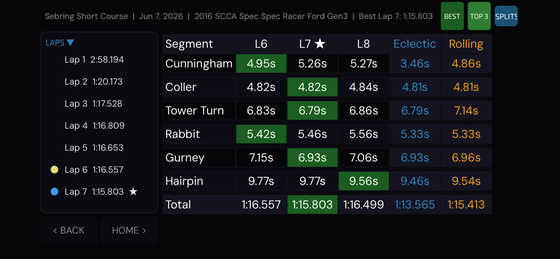
Afterward, the same per-segment numbers stack up lap over lap — so you can see exactly which corner you improved and which one gave the time back.
RaceVoice collapses that loop to zero. The analysis happens while you drive, because the analysis is just three measured speeds per corner and a clock. There's nothing to review between sessions to get the core benefit — the benefit arrives in real time, in your ear, and the next lap is the experiment. Every lap becomes a deliberate rep: hear your number, add a hair, confirm the new number, bank it, repeat. You're not driving twenty minutes and learning afterward. You're running twenty minutes of tight, measured, increment-by-increment practice, and you walk in already knowing what you did.
That's the logic of coaching, top to bottom. Not a model deciding what you need to hear. A patented method for measuring what your car actually did through a corner and handing it back to you — your number, your car, right now — at the one instant you can use it to go a little faster. Eyes up. Let the car talk to you.
Follow along as I build RaceVoice in public.
#RaceVoice · #DriveFasterEyesUp · #SpeedOfVoice · #Motorsport · #DriverCoaching · #MotorsportTech · #HPDE · #SpecRacerFord